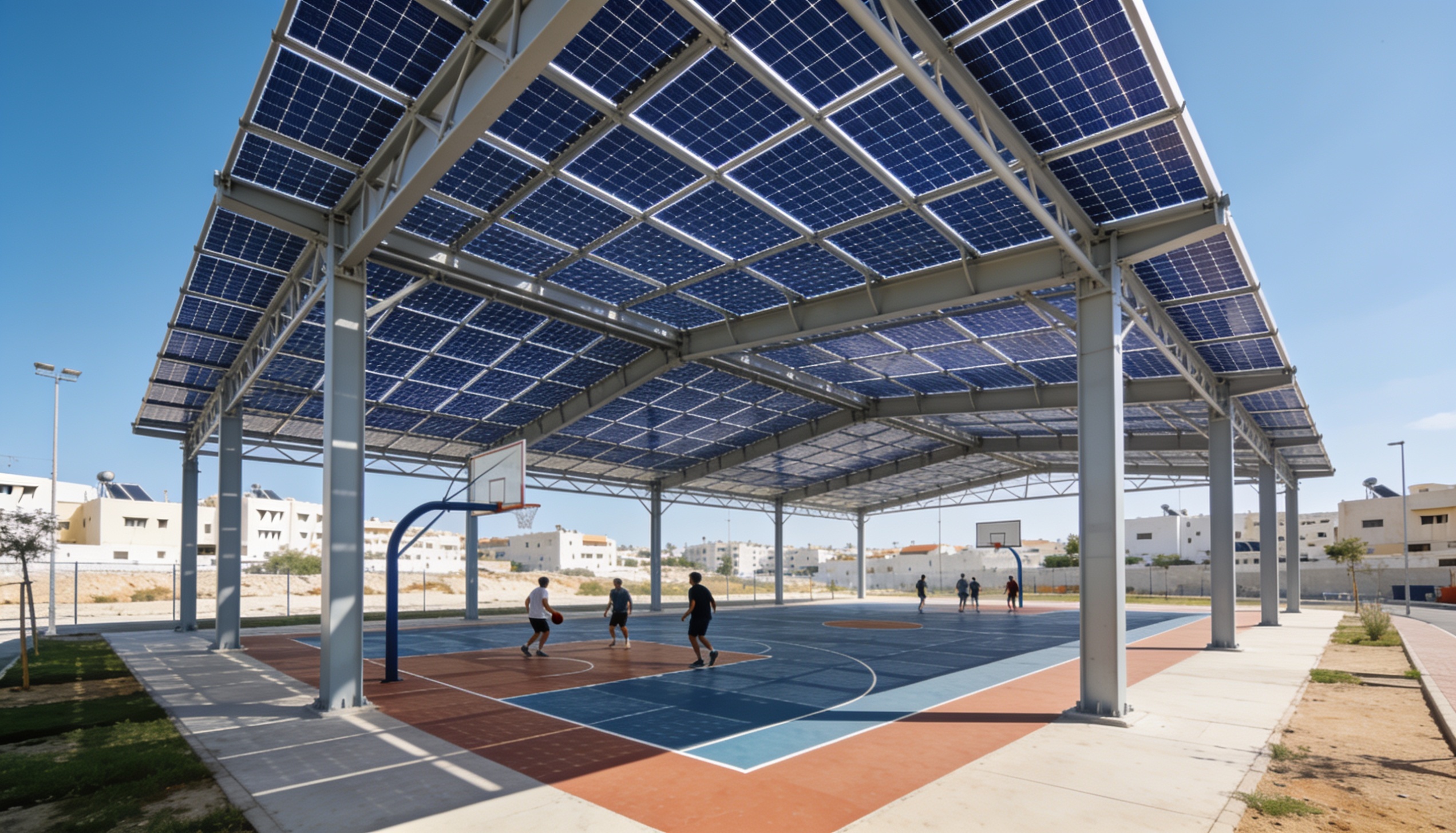
Background: Government Decision 3267. On 20 July 2025 the Israeli government adopted Decision 3267 on "accelerating the construction of combined canopies with a solar system for renewable-energy generation over sports fields." Following it, and with additional budget from the Fund for Israeli Citizens, the Ministry of Energy & Infrastructure published Call 29/2026 in May 2026 to support solar-canopy projects over municipal sports fields. The idea is simple and smart: a raised canopy over the court shades the playing surface while carrying photovoltaic panels that generate electricity fed into the grid.
Who can apply? A local authority (municipality, local council or regional council) that did not receive a grant in earlier related calls (Calls 46/2025 and 73/2025), or a regional cluster applying on behalf of a member authority. A separate application is required per authority, and support is given only for new canopies - both the structure and the solar system must be new.
Grant size: up to ₪450,000 and up to 50% of cost. The grant is set by the authority's socio-economic cluster: ₪450,000 for clusters 1-3, ₪375,000 for clusters 4-6, and ₪300,000 for clusters 7-10. In every case the grant will not exceed 50% of total project cost. The ministry estimates a project at roughly ₪1.2-1.5 million, so the authority funds the balance from its own resources - or from another government source, provided total public support does not exceed 90% of project cost. (Figures follow the call document; they are not a guarantee and are subject to ministry terms and actual budget.)
Technical requirements (Appendix 7). The system must meet a minimum of 80 kW DC installed capacity, at least 600 m² of canopy area, and a 6-metre net clearance from the ground - so as not to impair free use of the court. The canopy is connected to the national grid, includes LED lighting, and is designed by licensed engineers and architects per the Planning & Building Law, the Electricity Law and the relevant standards. The court must remain open to public use. Execution is allowed within 36 months of approval, and each authority receives a grant for one sports field only.
How applications are scored (100 points). Applications are ranked by criteria: the authority's socio-economic rating (up to 26 pts), a peripherality index (up to 20 pts), population (up to 14 pts), readiness and maturity - mapping potential courts, an initial architectural sketch, a generation report (PVSYST) and a grid-connection feasibility check (up to 35 pts), and municipal consumption reporting (5 pts). The budget is allocated by score from highest to lowest, until it is exhausted.
Deadlines and submission. Applications are submitted only through the Merkava (מרכב"ה) system. Per the call's timetable: a Zoom briefing on 7 June 2026, the deadline for clarification questions on 9 June 2026, publication of answers on 16 June 2026, and the final submission deadline on 23 June 2026. Applications not submitted on time are disqualified outright. (Dates reflect the call document and may be updated on the ministry website - verify against the official publication.)
What it means for authorities and planners. This is a chance to fund urban solar infrastructure with almost no competition for land: the sports field already exists, and the canopy simply adds shade and power generation. But the application demands a professional document package - mapping, an architectural sketch, a generation report and a connection-feasibility check - all of which directly affect the score. At Meniv Energy we accompany authorities and clusters from the initial mapping through grid connection, including the engineering design, generation reports and the paperwork with the ministry and the electric company.